
january reads
nerd time

I’ve been slowly trying to get back into reading more, as part of my commitment to rebuilding my attention span. It worked rather intermittently last year - in 2024, I read 17 new books. Which is perhaps not a lot, but I did exclude rereads, and also one of them was this seven hundred page behemoth of a novel about American military hegemony, narrative roles, and psychologically unwell gay people, so all in all it was probably more than enough words for one year. (Exordia by Seth Dickinson, if you’re wondering. This is not a recommendation, unless you are also psychologically unwell.)
This year I’m seeing significantly more success—I’ve read about a fourth of that number of books, and it’s only January. Granted, they are significantly smaller books, but we take wins where we can. Since the next bighuge essay I’m writing for this blog needs major revisions, I figured I may as well just take it easy and talk about a couple of those books that I liked from last month.
Bear in mind: these aren’t really reviews. If I wanted to make a book reviewing newsletter I would—but I don’t, simply because I don’t actually read all that many books in a year. (Maybe one day I’ll have a review website and I’ll be able to leverage it to request advance reader copies of books, but that day is not today.) These are mostly short essays and thoughts of the books. Treat each mention as a simple blanket recommendation; a note that this book may be worth your time. But we will have no ratings and no stars here.
At least, none in my words. You’re very welcome to look for stars in the books, though. I read science fiction for a reason.
The Dark Forest
by Cixin Liu (Trisolaris #2)
sold at Fully Booked
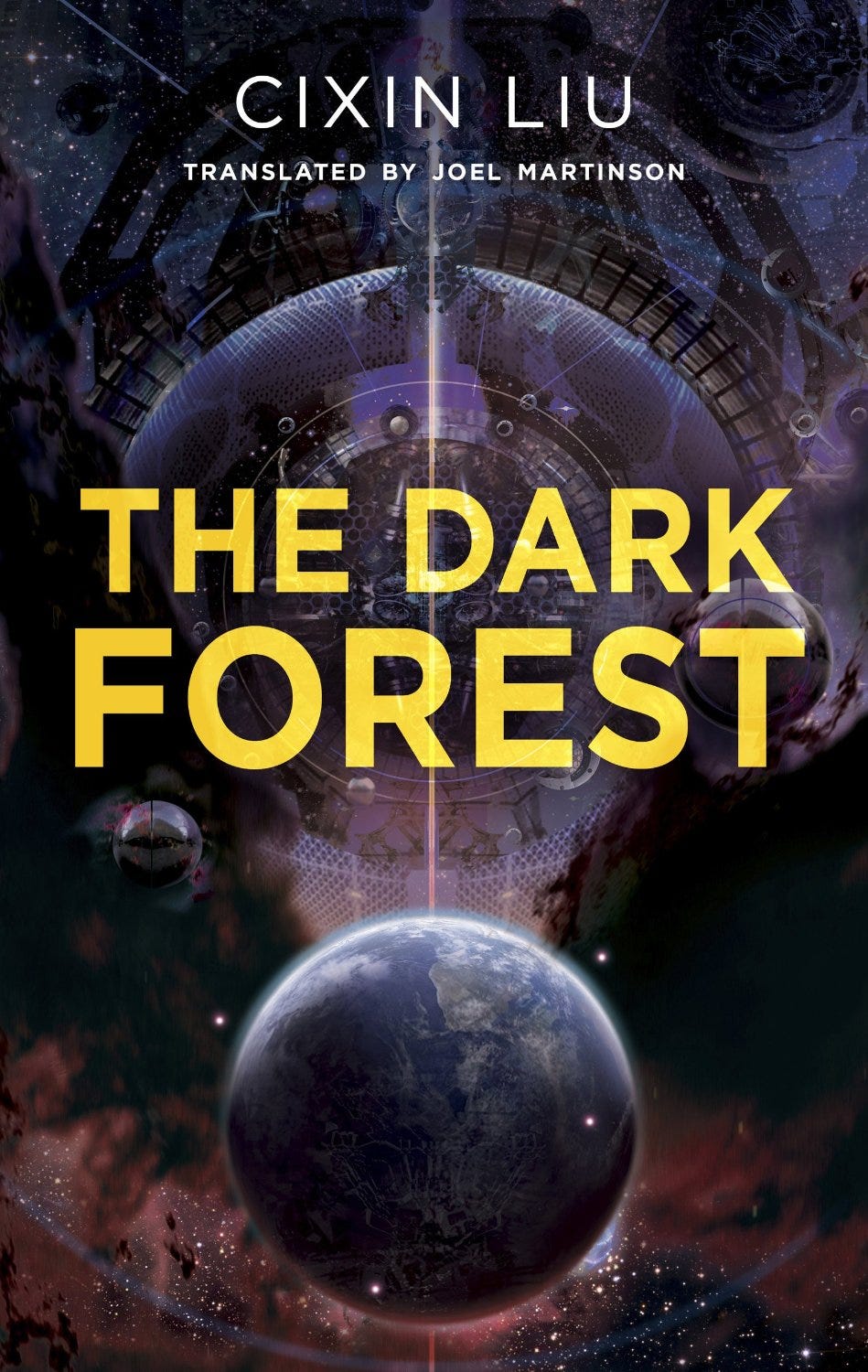
Liu’s works tend to take a little while to set up. I don’t know if it is because he doesn’t quite know how to hook the reader, or the subtle art of hooking the reader is not common practice in Chinese literature—certainly, I see this problem in many other Chinese-translated stories. Still, when this one gets going, it gets going. And I preferred it over the last book, simply because it is just so much bigger.
The Dark Forest is set in a near-future Earth that had just been informed that in four hundred years, an entire fleet of alien beings will invade the planet, destroy human society, and commandeer its resources for their own. Certainly there is a main character, and his own quest and story—but often it takes a back seat to the sociopolitical implications of alien invasion. How, for example, might the United Nations react? How would the common people? What might private enterprise do? What sort of thinking might emerge in those four hundred years; how would it affect the way events unfold?
Certainly it’s hard science fiction, in the vein of Asimov. But where hard sci-fi is typically hard when it comes to science and technology and natural sciences (and Cixin’s definitely written plenty of that, back in the first book The Three-Body Problem), this book is hard sociology. It is the science of society—how it evolves, how it changes. I always think that there’s more room in science fiction and fantasy for that sort of thing—but that’s the topic of another newsletter. (Everywhere I look I run into topics for newsletters.)
Hopefully Death’s End (the last in the trilogy) will be just as cinematic as the last two. I dunno though. Once again, I find myself dealing with that rocky Liu beginning. One day he’ll write a decent hook. Maybe.
Seek Ye Whore (And Other Stories)
by Yvette Tan
Sold at National Bookstore’s Shopee
CW: explicit sex, sexual assault, physical violence, gore
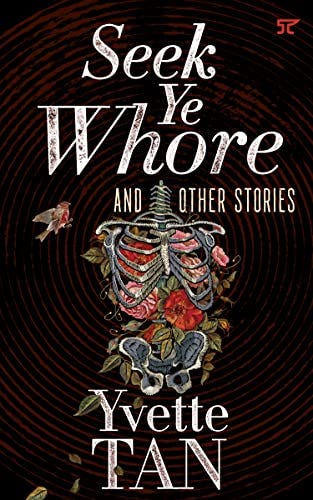
At the start of this semester, I lost a major battle in the IDGAF war and found myself the beadle of my only major subject: Creative Writing Workshop in Short Fiction. This has been a major blow to my cool and unbothered nature, and I find myself sorely wounded and unfit to continue fighting on the front lines. But roughly one or two sessions later, my creative writing professor told me that he wasn’t able to find an online copy of these two books that were required reading in his class—and if I could kindly photocopy two stories from these two books for his class?
I looked at the books, and looked at him. Can I read the books? I asked.
He said what? Yeah, sure, go for it.
And that is how I found myself with two whole books of Filipino short stories for free. One of them was Armor by John Bengan, and the other one is this. Seek Ye Whore (And Other Stories) by Yvette Tan, a collection of Filipino horror short stories.
As someone who mainly reads Western speculative fiction, seeing oneself in fiction in such a real and visceral way is a breath of fresh air. Tan, in her bionote, describes her fiction as something that can happen to anyone—even to you, dear reader. And reading it certainly feels that way. The characters are personable, relatable, honest—to the reader, if not to themselves.
And Tan bases her stories in the real-life contexts that you and I may have grown up in. One story is about sisig in the zombie apocalypse. Another is about a Filipino-Chinese boy haunting a girl that goes to an all-girls school next to an all-boys school separated by a church (wink wink, nudge nudge). Yet another—the titular Seek Ye Whore—is about a man who decides he wants a Filipino mail-order bride from Siquijor, and finds the woman he purchased arriving in severed body parts in the mail.
…okay, maybe they’re not all based in real-world context. But even when they aren’t, Tan bases her horror on some very culturally Filipino fears. This book is not for the faint of heart, or for children—there’s plenty of violence, sex, and sexual violence. But none of it is gratuitous. In fact, the sexuality of it is part of what makes it horrifying, and what makes it horrifying is also what makes it beautiful.
In the end, I liked this book so much that after I returned it to my professor, I purchased a copy of my own—along with Waking the Dead, Tan’s first short story collection, and several other books that may hopefully end up in this newsletter. One day. When I finish them.
Record of a Spaceborn Few
by Becky Chambers (Wayfarers #3)
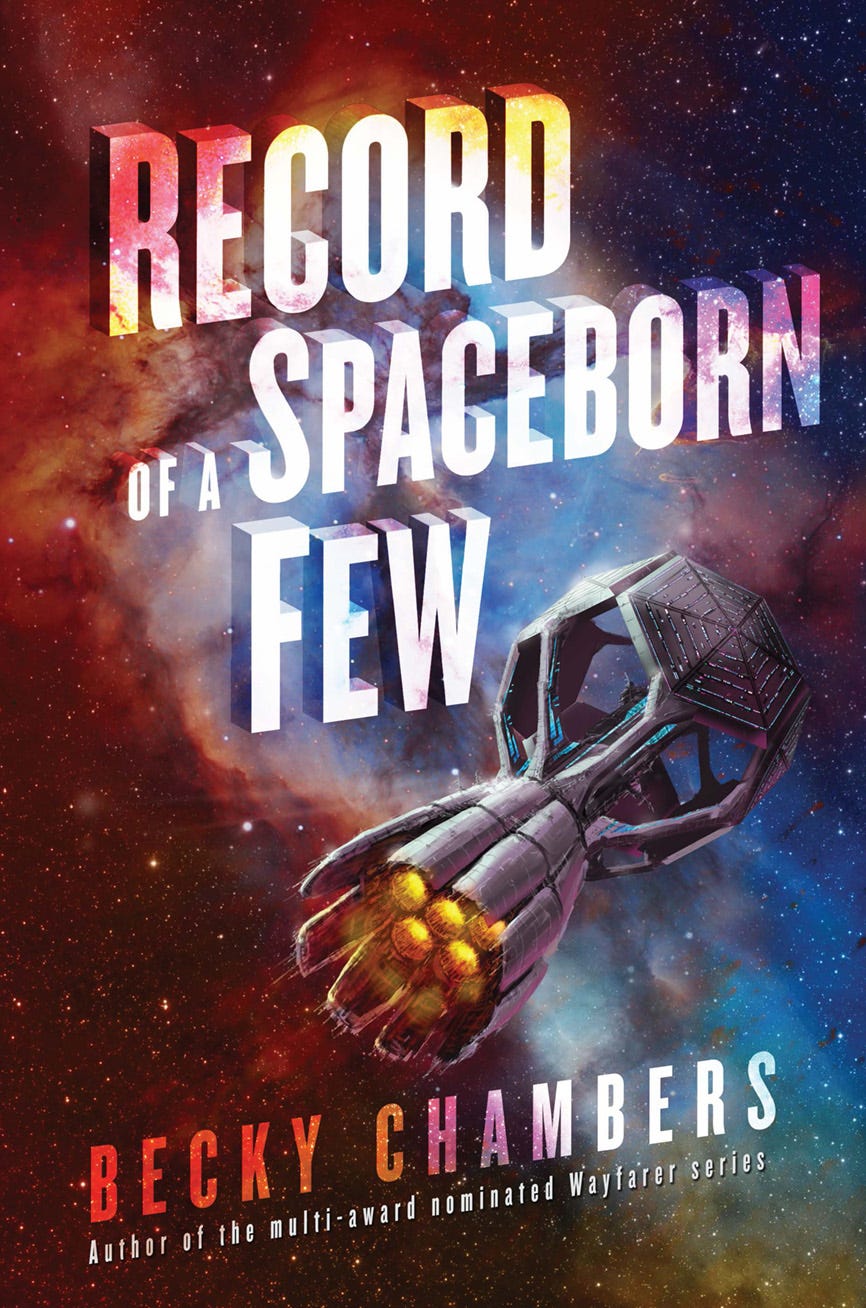
I was on a huge Becky Chambers kick last year, until I realized wait, I should probably be reading other authors too, and I paused in the middle of the Wayfarers series. She’s got a knack for cozy fiction that isn’t really cozy at all—it just feels cozy, up until the point where it smacks you on the back of the head with existentialism and you feel the residual questions of who am I and what is my place in the world roll around your head like marbles.
At least, that’s how Record of a Spaceborn Few feels. It’s centered entirely upon a generation ship—the Exodan Fleet, the last of the humans to leave destroyed planet Earth. It has been one generation since Humanity was accepted into the Galactic Commons (basically the United Nations, but for alien races) and the Exodan Fleet is now stationary, no longer stumbling around blindly in the big, dark universe, searching for somewhere they might be able to find home. The people live the same way that they did back when they were all alone; but times are changing, and each of the four main characters of the book don’t really know what to do with that.
I really do think Becky Chambers could be discussed as a philosopher at this point; her books, however speculative and science-fiction-y they may seem, are all examinations of major questions that follow humanity and personhood. The characters, then, are partially people, but also partially mouthpieces by which she examines the major themes of the book: vocation and purpose. What do you want to do in life? What does home mean to you? What about family? Tradition? All of these questions are asked of these characters at some point in the story, and all of these characters come up with answers true-enough. (They won’t be true forever, but such is the nature of existential truth.) In fact, these are all themes that come up later in her Monk and Robot duology—and while I think those two books, Psalm for the Wild Built and Prayer for the Crown-Shy are better books, this is not to diminish Record of a Spaceborn Few or to say that it’s prototypical.
In fact, considering my audience, I might even blanket-recommend it to all of you. Here is a book you might want to read if you are on the precipice of change and have no idea what you want to do. It might not have the answers, but it certainly invites you to ask the questions.
There’s no proper ending to this particular newsletter, because nothing’s ended—my goal to read more books will continue til I run out of books or my eyes bleed out of my skull. Really, considering the state of the modern news cycle, there’s no telling which one of those things will come first.
But I digress. I’ll see you all around. Bless.